Can You Get a Loan Against Your Car While Your Car Loan Is Still Running?
Already paying a car loan? Learn how to get a loan against your car through closure, refinance or top-up, and what it costs.

Yes, you can, but not directly. If your car is still under an active car loan, it is hypothecated to your lender, so a new lender cannot simply take it as security. You still have options. By closing, refinancing, or topping up your existing loan, you can unlock cash against your car's value even while EMIs are running. In this guide, we explain how each route works, how much money you can realistically get, what it costs, and which option may suit you.
Quick takeaways
• A running car loan means your car is hypothecated. Your RC carries the lender's 'HP' (hire purchase) endorsement.
• There are 3 routes: close the current loan first, refinance with a top-up, or take a top-up from your current lender.
• Cash in hand = eligible loan amount minus outstanding car loan minus charges.
• Check foreclosure charges, processing fees, and RTO costs before you switch.
Why does an existing car loan make this tricky?
When you buy a car on finance, the lender registers a hypothecation on the vehicle. In simple terms, the car is the lender's security until you repay the loan in full. Your Registration Certificate (RC) shows this as an 'HP' endorsement. Because of this, a new lender cannot register its own claim over the same car. Most lenders therefore prefer a lien-free car. That is why you first need to clear, refinance or top up the existing loan.
3 ways to get a loan against your car when you already have a car loan
The right route depends on how much you still owe, how much cash you have on hand, and the interest rates on offer.
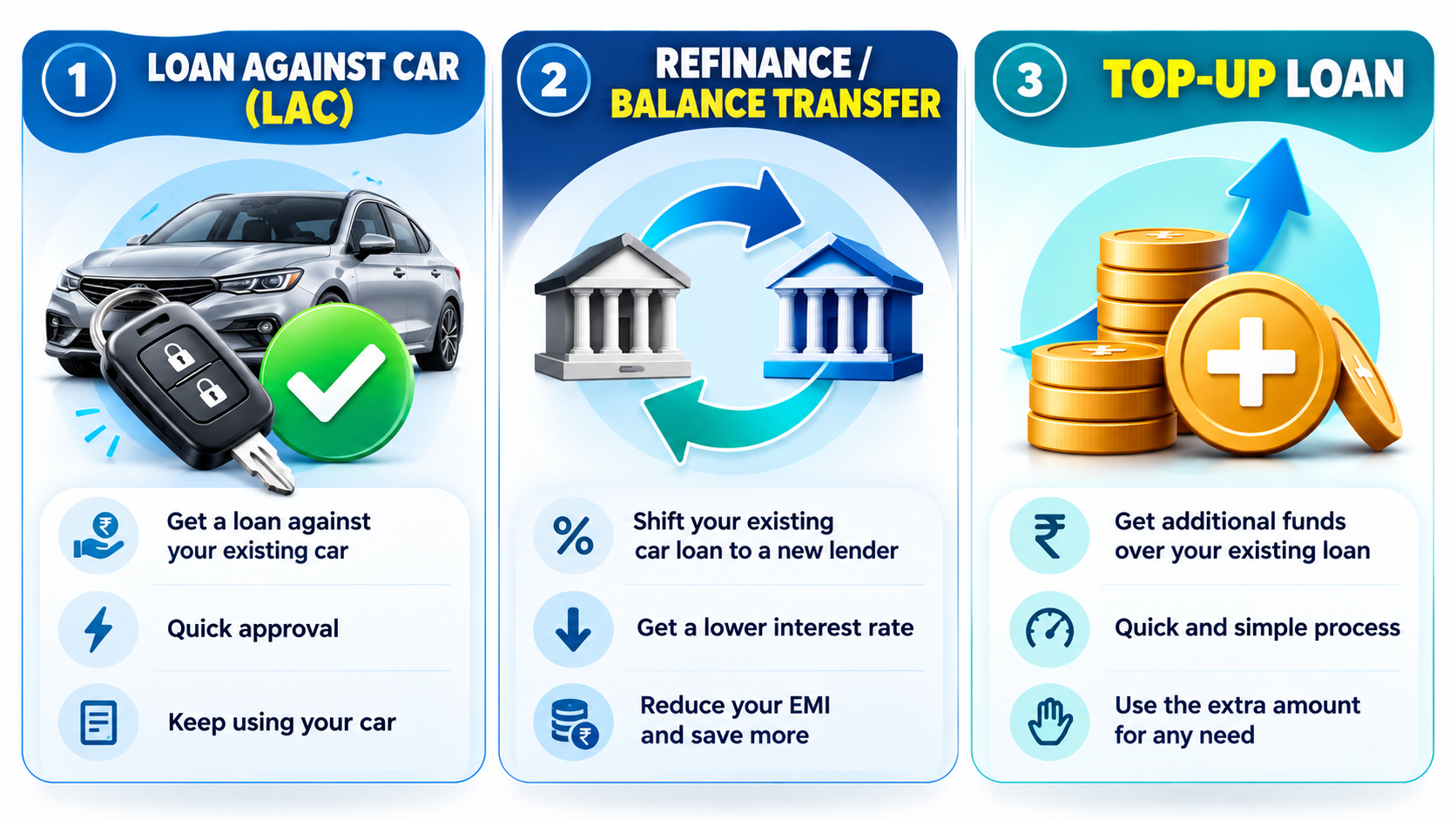
Option 1: Close your current car loan first
letter and NOC from your lender, and get the hypothecation removed from your RC. Once the car is lien-free, you can apply for a loan against car.
Best for: people with savings or a bonus who want the cleanest process and the best chance of a lower rate.
Downside: you need a lump sum upfront, and the paperwork takes time.
Option 2: Refinance with a top-up (balance transfer)
A new lender pays off your existing loan directly, takes over the hypothecation, and gives you the extra amount as cash.
Best for: borrowers whose outstanding balance is small compared with the car’s current value, or who can get a lower rate than they pay today.
Watch out for: foreclosure charges on the old loan and a processing fee on the new one.
Option 3: Take a top-up from your existing lender
Some banks and NBFCs offer top-up loans to customers with a good repayment record. The hypothecation stays with the same lender, so the paperwork is lighter.
Best for: borrowers who have paid EMIs on time for a reasonable period.
Downside: not every lender offers it, and the rate may be higher than a fresh loan.
Quick comparison
| Option | Upfront cash needed | Paperwork | Best for |
|---|---|---|---|
| Close loan, then apply | High | More | Those with savings |
| Refinance with top-up | Low | Medium | Those chasing a lower rate |
| Top-up from current lender | Low | Least | Those with a clean repayment record |
How much cash can you actually get?
Lenders decide the loan amount on your car’s current market value, not on what you paid for it. They then apply a loan-to-value (LTV) percentage that varies by lender, car age and your profile. Your cash in hand works out like this:
Cash in hand = Eligible loan amount − Outstanding car loan − Charges
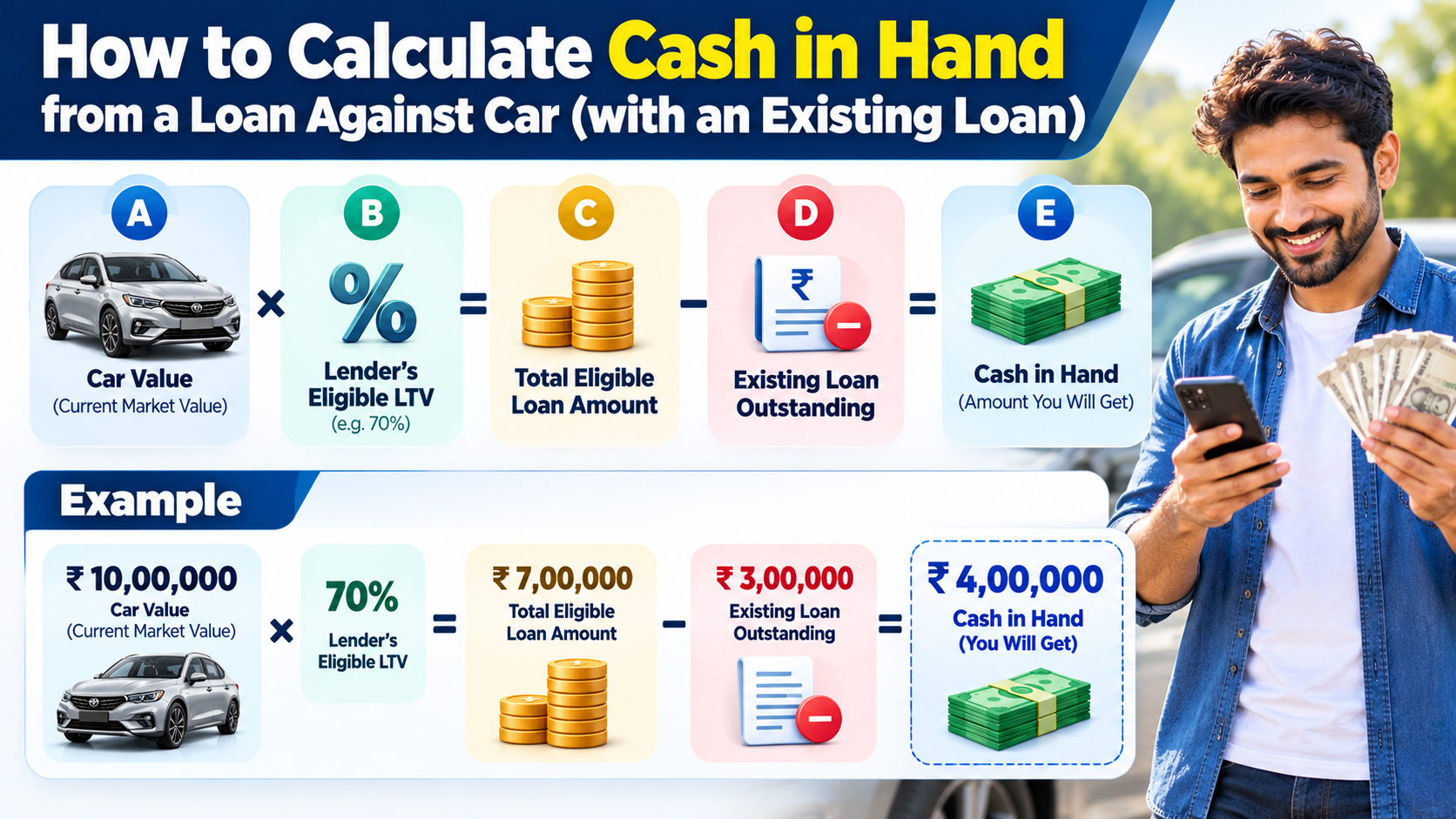
Example (illustrative only): Suppose your car’s current value is ₹8 lakh and a lender offers up to 60% of that, which is ₹4.8 lakh. If you still owe ₹2.5 lakh on your car loan, you may receive about ₹2.3 lakh before processing fees and other charges. Actual figures depend on the lender, your car and your profile.
Want to see what the new EMI could look like? Try our EMI calculator before you decide.
Eligibility checklist
Criteria differ from lender to lender, but most look for the following:
- The car is within the lender’s age limit and in good condition The RC is in your name and the insurance is valid
- A clean repayment record on your current car loan, with no recent bounced EMIs
- A healthy CIBIL score (many lenders prefer 700 or above)
- Stable income and a manageable debt-to-income ratio
Costs to check before you switch
The cheapest-looking offer is not always the best one. Add up every charge:
- Foreclosure or pre-closure charges on the old loan. Most car loans are fixed-rate, and such loans often carry a charge of a few percent of the outstanding principal. RBI rules restrict prepayment charges on floating-rate loans to individuals, but fixed-rate car loans usually still have them. Check your loan agreement.
- Processing fee on the new loan
- RTO charges for the hypothecation change
- Valuation and documentation charges
- Total interest. A longer tenure lowers the EMI but raises the total interest you pay.
A simple rule: switch only if your savings are clearly bigger than the total charges.
Documents usually required
- KYC: Aadhaar and PAN
- RC copy and valid insurance copy
- Income proof: salary slips or ITR, plus recent bank statements
- Existing loan statement and foreclosure letter (if refinancing)
- Address proof and passport-size photographs
Step-by-step process
- Check your car’s approximate current value and your outstanding loan amount.
- Check your CIBIL score so there are no surprises.
- Compare offers across lenders, including the total cost and not just the rate.
- Get a foreclosure statement from your current lender if you are refinancing.
- Submit documents and complete KYC.
- After disbursal, make sure the old hypothecation is removed and the new one is recorded on your RC.
Is it worth it? When it makes sense and when it does not
It may make sense if:
- You need funds for a genuine requirement such as a medical expense, business need or debt consolidation
- You can get a lower rate than your current loan, or the cash need is urgent
- You are confident about repaying the EMIs on time
Think twice if:
- The total charges eat up most of the benefit
- You are already stretched on EMIs, since a missed payment puts your car at risk
- A smaller personal loan or other option would be cheaper for your need
How your CIBIL score affects approval
Your CIBIL score and repayment history strongly influence both approval and the interest rate. A higher score usually means better terms. Checking your own score is a soft inquiry and does not reduce it, so it is a good first step. You can check yours for free with the Dymora CIBIL checker.
Frequently asked questions
Can I take a loan against my car if my car loan is still running?
Not directly, because the car is hypothecated to your current lender. You can close the existing loan, refinance it with a top-up, or take a top-up from your current lender.
Can I get a top-up on my car loan?
Some lenders offer it to customers with a good repayment record. Availability, rate and amount depend on the lender’s policy.
Will a loan against car affect my CIBIL score?
A new loan application can cause a small, temporary dip because of the credit inquiry. Paying EMIs on time helps your score over the long run.
How long does the process take?
It depends on the lender and the route. Closing and re-pledging takes longer because of NOC and RC paperwork, while a top-up from the same lender is usually faster.
Can I get a loan against a car that is not in my name?
Generally no. Most lenders need the RC to be in the borrower’s name.
What happens to the old hypothecation?
When the old loan is closed, the lender issues a NOC and the hypothecation is terminated at the RTO. In a refinance, the new lender’s hypothecation is recorded in its place.
Conclusion
A running car loan does not rule out a loan against car, but it changes how you get one. Whether you close the loan, refinance it or take a top-up, compare the total cost and not just the interest rate, and borrow only what you can comfortably repay.
Ready to see what your car can unlock? Check your loan against car options on Dymora.
Disclaimer: This article is for general information only and is not financial advice. Loan terms, rates and eligibility vary by lender and are subject to the lender’s policies. Figures shown are illustrative. Please read the loan agreement carefully before applying.
This article is for general information only and is not financial advice. Loan approval, interest rates and terms are decided by the lender. Check the latest terms with the lender before you apply.